


Are your teams struggling with low morale and unresolved conflict? Do you watch your managers avoid difficult feedback, knowing that previous ‘soft skills’ training has faded without lasting impact? You’re not alone in this frustrating cycle. The truth is, most conventional communication skills training for managers fails because it focuses on temporary scripts instead of addressing the root cause: a lack of foundational self-awareness.
This transformational guide for 2026 offers a different path-a new journey toward leadership excellence. Forget generic tips. Here, you will discover a powerful framework designed to build the deep-seated emotional intelligence your leaders need to truly connect, influence, and inspire. Prepare to empower your managers to navigate difficult conversations with confidence, foster genuine engagement, and cultivate a high-performing culture where your best talent chooses to stay and grow.
Key Takeaways
- Understand the true business cost of poor leadership communication by connecting it to measurable metrics like employee turnover and project failure.
- Discover why generic training falls short and how building foundational self-awareness is the key to authentic and impactful leadership.
- Effective communication skills training for managers is built upon four core pillars that move beyond scripts to foster genuine influence and inspiration.
- Learn how to accelerate mastery by integrating powerful frameworks like Emotional Intelligence (EQ) and the Enneagram to unlock your team’s true potential.
The True Cost of a Communication Gap in Your Leadership
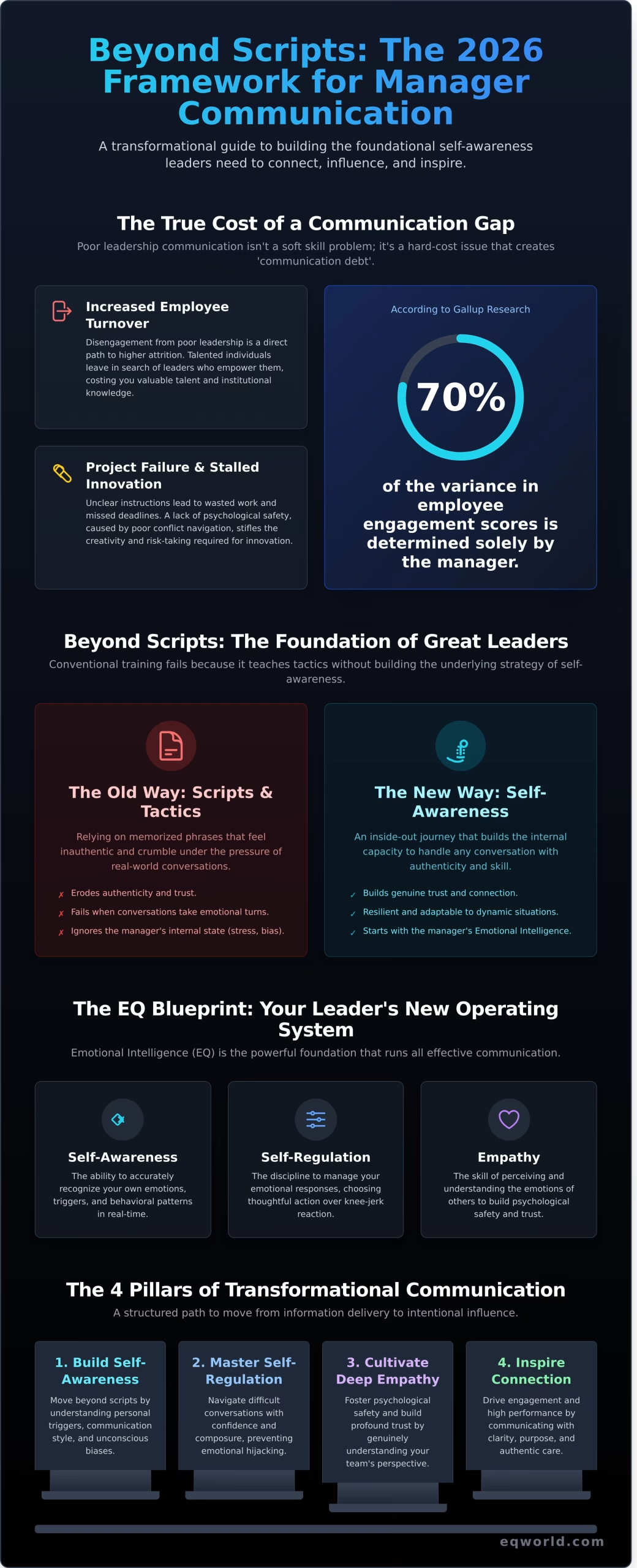
Beyond awkward meetings and unclear emails lies a significant, often unmeasured, business liability. Poor leadership communication isn’t just a soft-skill problem; it’s a hard-cost issue that silently drains your organization’s most valuable resources. This accumulating deficit, or ‘communication debt’, manifests as budget overruns, stalled innovation, and a revolving door of top talent. It’s the hidden tax on unrealized potential, paid for by every team with a manager who struggles to connect, clarify, and inspire.
From Misalignment to Mistrust
It often begins with a simple, unclear instruction that leads to hours of wasted work and a missed deadline. This misalignment, however, quickly compounds into something far more corrosive: mistrust. When feedback is inconsistent, poorly delivered, or absent altogether, employees feel insecure and undervalued. A manager who cannot skillfully navigate conflict or foster open dialogue erodes the psychological safety required for creativity and risk-taking, creating a team that prioritizes self-preservation over collaborative excellence.
The Ripple Effect on Team Engagement
A manager is the primary conduit for your company’s culture, vision, and values. When that channel is blocked, the impact is immediate and measurable. Gallup’s research confirms that managers are responsible for at least 70% of the variance in employee engagement scores. Leaders who lack core listening skills or fail to provide meaningful recognition leave their teams feeling invisible and disconnected. This disengagement is a direct pathway to higher attrition, as talented individuals leave in search of a leader who empowers them to grow.
This is particularly true in results-driven fields like digital marketing, where highly engaged teams are essential for delivering creative and effective campaigns. For an example of an agency that thrives on this principle, you can learn more about WE Interactive.
Many organizations attempt to patch these issues with conventional programs. However, traditional communications training that focuses only on presentation styles or email etiquette often fails because it doesn’t address the root cause. To achieve a true transformation, a more profound journey is required. Effective communication skills training for managers must be built on a foundation of self-awareness and emotional intelligence, empowering leaders to build the trust and clarity that fuel high-performing teams.
Beyond Scripts: The Self-Awareness Foundation of Great Leaders
Many leaders leave management training feeling equipped with scripts and models, only to find they fall flat in the real world of dynamic human interaction. This is the fundamental flaw in programs that teach communication tactics (what to say) without building the underlying strategy (the why and how). True transformation in leadership communication isn’t about memorizing lines; it’s an inside-out journey that begins with profound self-awareness.
Why Tactical Training Isn’t Enough
A script for giving difficult feedback is useless when a conversation takes an unexpected emotional turn. Relying on memorized phrases erodes authenticity, and your team can spot a disingenuous manager from a mile away. The most critical, yet often overlooked, truth is this: a manager’s internal state dictates their external communication. No amount of tactical communication skills training for managers can override the impact of unchecked stress, unconscious bias, or a distracted mind.
Emotional Intelligence: The Operating System for Communication
This is where Emotional Intelligence (EQ) becomes the essential framework. Think of EQ as the powerful operating system that runs all your communication “apps.” Without a stable OS, the apps will crash under pressure. For leaders, this system is built on three core pillars of mastery:
- Self-Awareness: The ability to accurately recognize your own emotions, triggers, and behavioral patterns in real-time.
- Self-Regulation: The discipline to manage your emotional responses, choosing thoughtful action over knee-jerk reaction.
- Empathy: The skill of perceiving and understanding the emotions of others, which is foundational to creating psychological safety and unlocking The Power of Bottom-up Feedback from your team.
Ultimately, effective leadership communication is the direct, tangible outcome of high Emotional Intelligence. It is the strategic capacity to perceive, manage, and leverage emotions to build trust and drive results. The journey to becoming a masterful communicator begins not with a script, but with a deep understanding of the self. To explore this foundational concept further, we invite you to read our pillar content on Self-Awareness: The Cornerstone of Emotional Intelligence.
The importance of these foundational skills is increasingly recognized, with specialized enrichment centers like SuperMinds now focusing on developing emotional intelligence and soft skills in children and teenagers to prepare them for future leadership roles.
The 4 Pillars of Transformational Managerial Communication
To elevate team performance, managers must move beyond simple information delivery and embrace a more intentional, impactful approach. Effective communication skills training for managers is built upon a framework that fosters genuine growth and tangible results. This journey toward leadership excellence rests on four foundational pillars: Clarity, Connection, Courage, and Coaching. Mastering these empowers leaders to not only direct their teams but to truly develop them.
Pillar 1 & 2: Building Clarity and Connection
Clarity and connection are the bedrock of high-performing teams, creating an environment of psychological safety where individuals thrive. Clarity eliminates ambiguity, while connection builds the trust necessary for collaboration and innovation. In today’s hybrid work landscape, these are more critical than ever.
- Set Crystal-Clear Expectations: For remote and hybrid teams, document everything. Use shared documents for project goals, define communication channel etiquette, and clearly state desired outcomes. This need for clear, digital documentation is so vital that even highly specialized industries rely on platforms like SOCWeld to prevent miscommunication.
- Practice Active Listening: Foster connection by listening to understand, not just to reply. Paraphrase what you hear (“So, what I’m hearing is…”) to confirm understanding and show your team they have been heard.
- Master Non-Verbal Cues: In virtual meetings, look at the camera to simulate eye contact. In person, maintain open body language. These small actions signal presence and build rapport.
Pillar 3 & 4: Leading with Courage and a Coaching Mindset
While clarity and connection build the foundation, courage and coaching are what accelerate growth and unlock hidden potential. This is where managers transform into mentors. It involves navigating difficult conversations with grace and shifting from a directive style to one of empowerment. This advanced focus is a core component of transformative communication skills training for managers.
To give feedback that inspires growth, use a simple framework: describe the specific Situation, the observable Behavior, and the resulting Impact. This data-driven approach removes judgment and focuses on actionable change. Then, shift from ‘telling’ your team the solution to ‘asking’ powerful questions like, “What’s one step you could take to approach this differently next time?” This coaching practice develops critical thinking, boosts ownership, and is proven to enhance employee development and retention.
Embracing this complete framework is a journey of self-awareness and skill development that yields profound results for you and your team. See how our programs build these four pillars.
Accelerate Mastery with EQ and the Enneagram
Mastering the core pillars of managerial communication requires more than just theory; it demands a profound understanding of human motivation. At EQ World, we provide the framework to accelerate this journey. Our pioneering methodology combines the practical skills of Emotional Intelligence (EQ) with the deep personality insights of the Enneagram, creating a true communication ‘superpower’ for leaders.
This integrated approach moves beyond one-size-fits-all advice. It equips you with a practical toolkit to authentically connect with, motivate, and lead every individual on your team. This is the cornerstone of transformative communication skills training for managers-turning abstract principles into tangible, everyday leadership excellence.
The Enneagram as a Communication Blueprint
The Enneagram is not a tool to label or limit people. Instead, it is a dynamic and powerful map to the core fears, desires, and motivations that drive human behaviour. By understanding this internal landscape, you can tailor your communication with unparalleled precision and empathy. For example:
- Giving feedback to a Type 3 (The Achiever): Frame it around efficiency, goals, and winning. Show them how adjusting their approach will lead to greater success and recognition.
- Giving feedback to a Type 9 (The Peacemaker): Deliver it privately and supportively. Emphasise how their actions contribute to team harmony and stability, ensuring they feel valued and not conflicted.
This insight builds genuine empathy, reduces unconscious bias, and transforms difficult conversations into opportunities for growth. To begin your journey, explore our Enneagram Certification in Singapore guide.
A Proven Path to Measurable Growth
Theory alone does not create change. Our workshops are designed as experiential labs where managers apply these powerful tools in real-world scenarios. Through guided practice and professional facilitation, leaders learn to navigate complex team dynamics with confidence and skill. Client case studies consistently show that our approach leads to a measurable impact, including enhanced team cohesion, higher psychological safety, and improved performance metrics.
Furthermore, our commitment to excellence is validated by our status as a provider of WSQ-certified courses. This recognition in Singapore stands as a mark of quality, ensuring our communication skills training for managers meets rigorous standards for impactful, professional development.
Designing Your Manager Training Program: A Path Forward
Understanding the profound impact of effective manager communication is the first step. Now, it is time to transition from insight to action. Building a high-performing, psychologically safe culture requires a deliberate and strategic approach to leadership development. This guide provides a clear path to implementing a program that delivers tangible, lasting results and truly enhances team performance.
Your Implementation Checklist
Launching a successful initiative begins with a solid foundation. Use this four-step checklist to navigate the essential stages of planning and executing a world-class communication skills training for managers.
- Step 1: Identify Specific Communication Challenges. Go beyond generic assumptions. Survey your teams, conduct focus groups, and analyze performance data to pinpoint the exact friction points-be it unclear feedback, poor conflict resolution, or a lack of inspirational leadership. Applying data-driven insights to understand human motivation is a powerful approach, and for broader business challenges, consultancies like Human Instinct specialize in this area.
- Step 2: Secure Leadership Buy-In. Frame the investment as a business imperative. Present a clear case linking enhanced communication to core KPIs like employee engagement, retention, and productivity. Show how this training directly addresses the challenges you identified.
- Step 3: Choose a Program That Fosters Self-Awareness. Many programs teach tactics, but lasting change comes from within. Prioritize training rooted in Emotional Intelligence (EQ), helping leaders understand their own motivations and impact before they learn new techniques.
- Step 4: Plan for Reinforcement and Follow-Up. Transformation is a process, not a one-day event. Ensure your program includes post-workshop coaching, peer accountability groups, or digital resources to embed new behaviors into daily leadership practice.
These steps are particularly crucial for organizations where process adherence and quality control are paramount. Effective managerial communication is not just a ‘soft skill’ but a core competency required for implementing and maintaining rigorous quality management systems like ISO 9001. If this is a priority for your business, you can find out more about the role of leadership in achieving certification.
Begin Your Transformation Journey with EQ World
At EQ World, we believe that true leadership mastery begins with self-mastery. Our approach is uniquely powerful because it is EQ-based, Enneagram-powered, and relentlessly results-driven. We move beyond surface-level skills to facilitate a profound transformation in how your managers connect, influence, and inspire.
We partner with leading organizations to deliver tailored corporate solutions and also offer public certification courses for individual leaders ready to accelerate their growth. Our programs provide the practical tools and deep self-awareness needed to build exceptional teams. The journey to unlocking your organization’s full potential starts now.
Empower your leaders. Transform your organization. Contact us for a consultation.
Your Journey to Transformational Leadership Begins Now
As we look toward 2026, it is clear that exceptional leadership is built on a foundation of authentic communication, not just theory. Moving beyond simple scripts to embrace self-awareness and emotional intelligence is what separates good managers from great ones. Investing in the right communication skills training for managers is no longer an option-it is the most critical step toward closing costly communication gaps, boosting team morale, and driving organizational excellence.
At EQ World, we have spent over 20 years empowering leaders to achieve this transformation. Our pioneering, WSQ-accredited courses are trusted by leading organizations like HSBC and Singapore Airlines because they deliver measurable impact and tangible growth. We provide the frameworks and practical tools your managers need to unlock their full potential and inspire their teams.
Are you ready to build a new generation of empowered, self-aware leaders? Start your transformation journey. Explore our leadership programs. The future of your organization depends on the connections you build today.
Frequently Asked Questions
What are the 5 essential communication skills for managers?
Effective managers master five core communication skills to empower their teams. These include active listening to truly understand team members, providing clear and constructive feedback for growth, and demonstrating empathy to build trust. Additionally, mastering non-verbal communication and navigating conflict resolution are crucial. Developing these skills transforms a manager’s ability to lead, inspire, and drive performance, laying the groundwork for a thriving team environment.
How can you measure the effectiveness of communication skills training?
We measure the transformative impact of our training through a blend of qualitative and quantitative metrics. This includes pre- and post-training assessments, 360-degree feedback from direct reports, and tracking key performance indicators like employee engagement scores, productivity levels, and staff retention rates. This data-driven approach ensures our communication skills training for managers delivers tangible growth and a measurable return on investment for your organization.
What should a comprehensive communication training program for managers include?
A comprehensive training program must blend foundational theory with practical, real-world application. Key modules should cover active listening techniques, structured feedback models, and proven conflict resolution strategies. Crucially, it must integrate Emotional Intelligence (EQ) to foster self-awareness and empathy. Our programs also incorporate powerful frameworks like the Enneagram to help managers understand and adapt to diverse communication styles, ensuring lasting and impactful behavioral change.
How do you improve a manager’s communication with their team?
Improving a manager’s communication is a continuous journey of intentional practice. Key actions include scheduling regular, structured one-on-one meetings, actively soliciting feedback on their own communication style, and practicing transparency whenever possible. By consciously applying skills like active listening and providing consistent recognition for team contributions, managers can build a culture of psychological safety and trust, which accelerates team performance and fosters genuine connection.
What is the role of Emotional Intelligence in managerial communication?
Emotional Intelligence (EQ) is the cornerstone of effective managerial communication. It empowers leaders with the self-awareness to understand their own impact and the empathy to connect with their team on a deeper level. A high-EQ manager can regulate their responses, navigate difficult conversations with grace, and inspire trust. This mastery of emotion is what transforms standard communication into a powerful tool for motivating teams and unlocking their full potential.
Is this training suitable for new managers as well as experienced leaders?
Absolutely. Our communication skills training for managers is designed to empower leaders at every stage of their journey. For new managers, it provides a powerful foundation of essential skills to build confidence and start effectively. For experienced leaders, it offers an opportunity to refine their approach, unlearn outdated habits, and discover advanced techniques to elevate their impact. The core principles of connection and self-awareness are universally transformative for all leaders.
Can this training be customized for our company’s specific needs?
Yes, customization is at the heart of our approach to ensure maximum impact. We work closely with you to understand your unique organizational culture, industry challenges, and specific leadership goals. Whether you need to address communication in a remote team, navigate high-stakes client interactions, or align with specific corporate values, we tailor the content, case studies, and practical exercises to deliver a truly relevant and transformative learning experience for your managers.
What is the Enneagram and how does it help with communication?
The Enneagram is a powerful and insightful framework that reveals the core motivations driving nine distinct personality types. In the context of communication, it serves as a transformative tool for self-discovery. By understanding their own Enneagram type and those of their team members, managers can move beyond surface-level interactions. This deeper awareness allows them to adapt their communication style, pre-empt misunderstandings, and build more authentic and effective relationships.